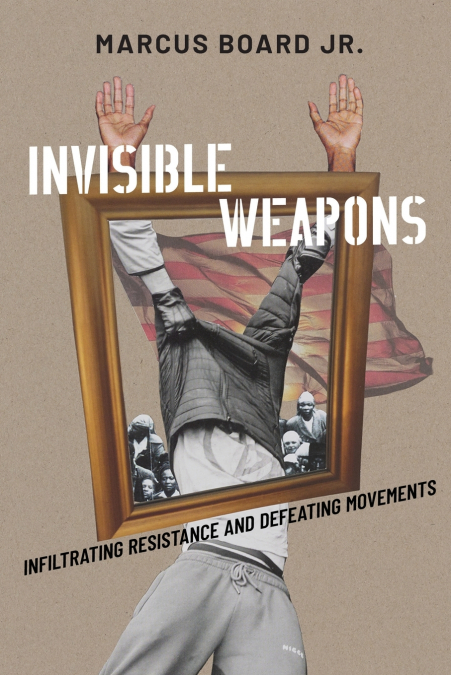
Marcus Board
Radicalism is an inclusive political tradition that lives on in the Movement for Black Lives (M4BL). Key radical principles include empowering people to advocate for themselves and their communities, the idea that power must embrace accountability, and a transformative interpretation of justice and change. Everyone is not a radical any more than everyone supports the M4BL. And yet, some people claim to support the M4BL while rejecting radical movement principles and often practicing deeply anti-radical politics. In Invisible Weapons, Marcus Board Jr. wrestles with these contradictions and reveals the key political stumbling blocks posed by government powerbrokers--from elected officials to welfare-bureaucrats--in the face of radical political movements. Board shows how neoliberalism is synonymous with anti-radicalism and uses invisible weapons that stop oppressed people from advocating for their own needs and grievances. Board argues that the insidious power of co-optation is transforming participation in mass social movements, potentially rendering active resistance ineffective. To support his argument, he looks at long-term unemployed Black welfare recipients in Chicago, original survey data, and case studies of police shootings in Baltimore and New York. At the center of Invisible Weapons are the seemingly conflicting responses to the 2015 Baltimore City police murder of Freddie Gray Jr. and the 2016 neglectful non-response to the Baltimore County police murder of Korryn Gaines. Beyond geography and personal histories, Board shows that Gray and Gaines are also deeply connected by the myriad systemic failures that shaped their lives. And the aftermath of their deaths further reveals the ways that oppressed masses are being silenced by the state under a veil of anti-radicalism. Invisible Weapons teaches us how state co-optation of social movements like the M4BL is stealing power from people. This happens both in revolts like the Baltimore Uprising, when people are consciously resisting, and in cases memorialized by countless #SayHerName campaigns, when the masses are conspicuously absent. Neoliberalism and its proponents are creating an anti-democratic political landscape by convincing people falsely that radicalism has no place in U.S. politics. But strategies of non-violence, equality, and cooperation alone are insufficient means to regain this lost power and to stop lives from being destroyed. Grassroots resistance must also return to radicalism, remaining inclusive while also rejecting co-optation politics, embracing political and community self-defense, and recommitting to abolition.