Inicio > Humanidades > Historia > Code Collar 2030
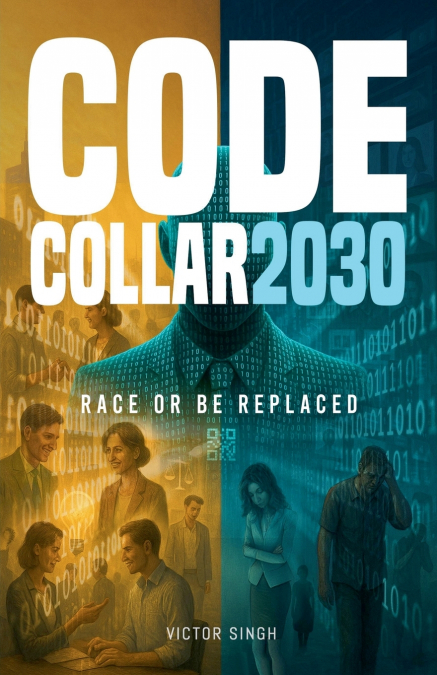
Code Collar 2030

Code Collar 2030

Victor Singh

16,17 €
IVA incluido
Disponible
Editorial:
Ingram Publisher
Año de edición:
2025
Materia
Historia
ISBN:
9788269333534
16,17 €
IVA incluido
Disponible
Añadir a favoritos

You are a knowledge worker. You think for a living. And by 2030, that may no longer be enough.Code Collar 2030 is a thoroughly researched, deeply personal, and unflinching examination of what artificial intelligence is doing to the people who work with their minds - not their hands.Victor Singh spent nine months and 1,500 hours writing this book. A knowledge worker with two decades of experience, an immigrant’s perspective, and a front-row seat to Norway’s cautious relationship with innovation, he asks the question most people in his position are quietly afraid to ask: What am I worth when a machine can do what I do - faster, cheaper, and without calling in sick?The title says it all. 'Code' is what AI fundamentally is - strings of computational logic. 'Collar' has always signified labor class: blue-collar, white-collar, pink-collar. Code Collar names the new category that is quietly absorbing them all: work done by, and through, algorithms. The '2030' is not a prediction - it’s a deadline.The book is structured in three movements. The first lays the intellectual groundwork: from Gutenberg’s printing press to the zettabyte era, through the evolution of AI and the mechanics of prompt engineering. The second shifts inward, to the human side of the equation - the cognitive biases we carry into AI systems, why trust erodes or holds, how Generation Z is rewriting the rules of work, and what job polarization actually looks like from the inside. The third is profession by profession: middle managers, project leaders, lawyers, real estate agents, software engineers, and the wealth managers overseeing Norway’s $1.9 trillion sovereign oil fund.Throughout, Singh weaves in his own story - a father who owned a pizza restaurant and whose labor couldn’t be outsourced to an algorithm; a son who rents his relevance month by month, certification by certification, billable hour by billable hour. It’s a contrast that cuts to the heart of the book: the 'working class' hasn’t disappeared. It’s just wearing a different collar.Singh draws on Schumpeter’s creative destruction, Drucker’s knowledge worker framework, Kahneman’s cognitive biases, and over 500 research papers and articles reviewed during the writing process. He also gives honest attention to Norway’s specific vulnerabilities: a country ranked 2nd in global productivity in 2022 that had slipped to 5th by 2024, with a five-year estimated lag in generative AI adoption behind the US, China, and India - all while sitting on one of the world’s largest sovereign wealth funds and a diminishing appetite for risk.The book closes with a genuine dilemma rather than a tidy resolution. Singh sees three likely futures for knowledge workers: Universal Basic Income, legislated human workforce minimums, or some combination of the two. He isn’t sure which he prefers. What he is sure of is that passive acceptance is not a strategy.Code Collar 2030 features a foreword by Maxim Salnikov, AI Apps and Developer Productivity GTM Lead at Microsoft Western Europe, and an afterword by Eirik Norman Hansen, entrepreneur, futurist, and author.This is not a book about technology. It is a book about what it means to be a knowledge worker - and whether that still means something - in the age of intelligent machines.


Artículos relacionados

  • Raising Freedom's Banner
    Paul Harris
    World wide history of peaceful street demonstrations from their earliest beginning in eighteenth century England to their use throughout the world in the twenty-first century. Describes why some demonstration movements succeeded and others failed. Contrasts demonstrations within the law with civil disobedience demonstrations. Describes Peterloo, the Chartists, the Suffragettes,...
    Disponible

    23,59 €

  • Waipi’o Valley
    Jeffrey L. Gross
    Waipi’o Valley: A Polynesian Journey from Eden to Eden recounts the remarkable migrations of the Polynesians across a third of the circumference of the earth. Their amazing journey began from Kalana i Hau’ola, the biblical “Garden of Eden” located along the shore of the Persian Gulf, extended to the Indus River Valley of ancient Vedic India, to Egypt where some ancestors of the...
  • Floralia
    June Rainsford Butler
    A century characterized by a growing interest in science, the opportunity for travel, and leisure for gardening furnishes the setting for Butler’s book. The rise of landscape gardening in England is traced, and the origin and history of its most famous gardens are given. The close relation between England and America in the field of horticulture is also discussed.Originally pub...
    Disponible

    61,20 €

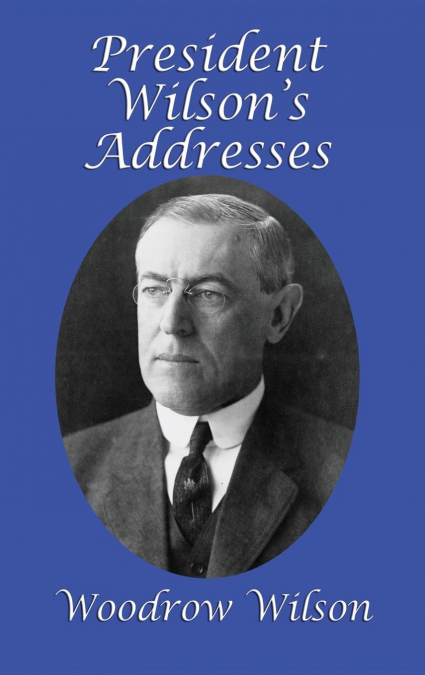
  • President Wilson’s Addresses
    Woodrow Wilson
    'These addresses of President Woodrow Wilson are almost entirely concerned with political affairs, and more specifically with defining Americanism. Yet they also show that even as he moved from academia to the heights of politics, Wilson retained something of the teacher’s interest in showing the relation between specific instances and the general forms of thought or action of ...
  • The Story of my Life
    John Albert Macy
    The Story of My Life, is Helen Keller’s autobiography detailing her early life, especially her experiences with Anne Sullivan. The book is dedicated to inventor Alexander Graham Bell. The dedication reads, 'To ALEXANDER GRAHAM BELL Who has taught the deaf to speak and enabled the listening ear to hear speech from the Atlantic to the Rockies, I dedicate this Story of My Life.' ...
  • The Story of My Life Vol. 6 Spanish Passions
    Giacomo Casanova
    Casanova was an Italian adventurer and author from the Republic of Venice. His autobiography, Histoire de ma vie (Story of My Life), is regarded as one of the most authentic sources of the customs and norms of European social life during the 18th century. He has become so famous for his often complicated and elaborate affairs with women that his name is now synonymous with 'wom...

Otros libros del autor

  • Code Collar 2030
    Victor Singh
    By the year 2030 the knowledge worker will be a thing of the past. The easy life of lawyers, middle managers and software engineers is coming to an end. A new reality is taking over where artificial intelligence does not just help the knowledge worker it actually does the job of the knowledge worker. This means artificial intelligence is replacing the knowledge worker and the k...
    Disponible

    19,23 €